Core Technology

DexForce' s world-class team leads in AI, computer vision, generative 3D, and 3D perception large models. Frontier research drives our DexVerse™, AI, and synthetic data engine to realize general robot intelligence.

EmbodiChain
Automated, Efficient, and Modular Platform for Scaling Up Embodied AI Learning
Learn More
DexGen Data
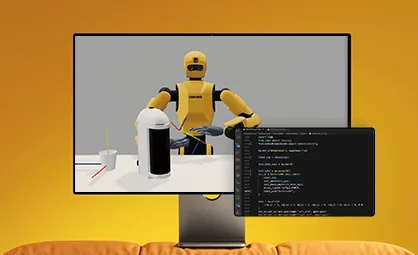
DexSim Simulation
DexAI Model
DexGen Data

- Research: 3D/4D data generation & characterization (3D reconstruction, unified geometric/physical representation, text-to-3D) supporting robot learning.

- Pioneered 3D/4D representation/generation precision-guaranteed, fast automated large-scale high-quality 3D data.

DexSim Simulation

- Research: High-fidelity virtual environments for robot learning’s massive interactive data needs (includes physics/rendering, efficiency, data augmentation).

- Quantity-to-quality leap: Scalable data augmentation + real-world-approaching perception & physics.

DexAI Model

- Research: Enabling learning and reasoning in robotic agents through end-to-end embodied intelligence, with a focus on Sim2Real transfer and multimodal large model integration.

- Via DexGen & DexSim' s efficient automated data pipeline, it establishes a full AI capability system: affordance understanding, natural interaction, and general manipulation.

Technological Achievements
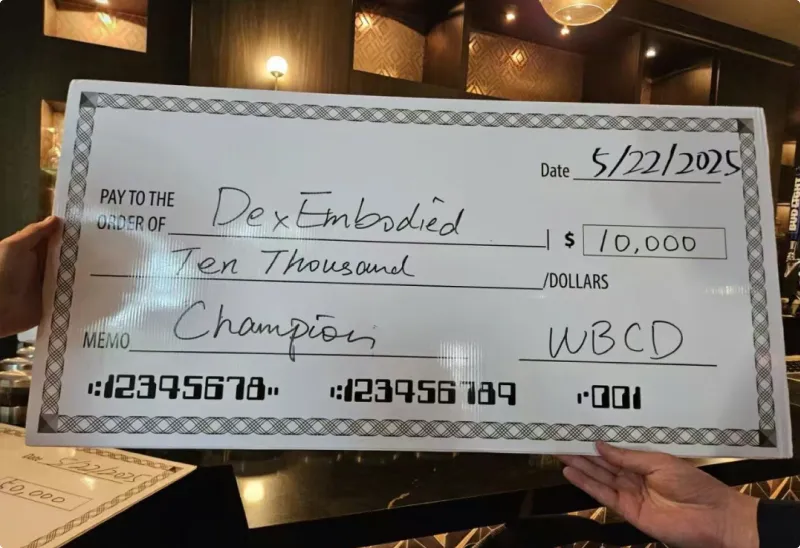
Champion of the 1st WBCD Dual-Arm Robot Challenge
Top Prize at the World-Class Robot Competition
IROS Object Pose Estimation: Multiple championships/runner-ups
F-ConvNet/HotSpotNet: Top ranks on KITTI (autonomous driving benchmarks)
DualPoseNet: No.1 accuracy on NOCS (full-DOF pose estimation)
SRDC: Top precision on synthetic-to-real autonomous driving transfer benchmark
IEEE BTAS 2016: 1st in Video Person Recognition Evaluation
Intelligent visual rock-crushing system (Finnish quarries) – efficiency boost
GPNet et al.: deep learning unregistered object grasping + largest simulated dataset
World’s first 3D AffordanceNet: 3D affordance method + benchmark dataset (supports HRI R&D)
SkeletonNet/ToMoNet: first deep learning complex topological surface generation; CVPR 2019 Best Paper Candidate
Analytic Marching (lossless meshing theory/algorithm) – AnalyticMesh open-sourced
Adaptive deep model optimization: bridges MVS & deep reconstruction, enhancing MVS performance
Please fill out the form below. Our expert advisor will contact you shortly!
Inquiry:
Notes:
Cancel
Submit